I. (Reel 5) Impressionistic to the point of incoherence. Starting with troops disembarking at a harbour. Marching columns, some of them identified: the Devonshire Regiment, some Scots, the Bedfordshir...
The King arrives at Calais and meets various military and civilian dignitaries. He is taken to General Haig's château at Beauquesne where with Haig and the Prince of Wales he meets President Poincar...
The King, in Field Marshal's uniform and unaccompanied by other members of the Royal family, arrives at Calais on HMS Whirlwind on 5 August. Three days later he inspects British and US pilots of RAF 1...
(Reel 1) Near Bapaume a German "anti-tank gun" lies in an unidentifiable wreck with its crew dead beside it. Shells burst in the distance. Two 6-inch Mk VII guns are drawn by Holt tractors to new posi...
(Reel 1) Most of the scenes are of Indian troops of 15th Cavalry Brigade, 5th Cavalry Division. Also shown in the advance are the Nottinghamshire Battery, Royal Horse Artillery and 'A' Battery of the ...
I. The film is outspoken, "The evidence - both documentary and otherwise - is now ample to prove that Germany forced this great and terrible War upon humanity to secure for herself the domination of t...
I. The film is often disjointed, but covers the transfer of American manpower and matériel across the Atlantic, culminating in their first major engagement in the Battle of Château-Thierry in June 1...
(Reel 1) Albert Cathedral, mid-1916. The Canadian 6th Brigade, 2nd Division, led by Brigadier-General H D B Ketchen (past German prisoners) towards the battlefield, halts to rest at La Boisselle cross...
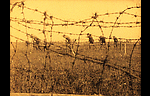
The battle of Zborov: Soldiers overcoming barriers with barbed wires.
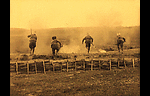
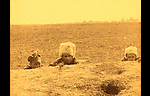
The battle of Zborov: Four soldiers run out a trench.
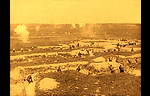
The battle of Zborov: A system of trenches with soldiers.
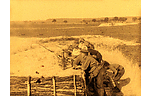
The battle of Zborov: Volunteers in the trench before the assault.
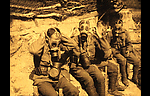
The battle of Zborov: Four Austrian soldiers in gasmasks.
The battle of Zborov: Four Austrian soldiers in the trench with gasmask cases around their necks.
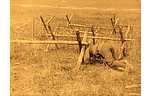
The battle of Zborov: An injured soldier in the barbed wire barrier.
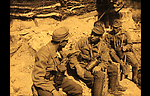
The battle of Zborov: Three soldiers in the trench, Tomeš in the middle.
O. Verf.. „Krieg und Kino.“ Der Kinematograph 397 (1914): 3-4. Bericht, wie bislang der Film in Kriegen eingesetzt worden sei. Ratschläge an Kinobesitzer, wie sie sich zu verhalten hätten. Mutma...
O. Verf.. „Mars regiert die Stunde.“ Der Kinematograph 397 (1914): 5-8. Aufruf an die Kinoindustrie, sich angesichts des Krieges in die Dienste des Vaterlandes zu stellen. Vorschlag, möglichst ak...
Mit der Kamera in der Schlachtfront.“ Der Kinematograph 397 (1914): 7. Werbeanzeige, die die Bedeutung der Filmaufnahmen gerade angesichts des drohenden Krieges hervorhebt.
Aubinger, Josef: „Die Kinematographie in Kriegszeiten.“ Der Kinematograph 398 (1914): 3-5. Artikel, der die mögliche Zukunft des Kinowesens im Krieg beschreibt. Die wirtschaftliche Lage der Kinos...
O. Verf.. „Schliesst die Kinos nicht.“ Der Kinematograph 399 (1914): 3-4. Aufruf an die Kinoindustrie, die Kinos nicht zu schließen, da das Volk in Kriegszeiten Ablenkung brauche. Die Eintrittspr...
Monopolfilm-Vertriebs-GmbH..“Patriotisches Kriegs-Programm.“ Der Kinematograph 399 (1914): 5. Werbung für das aktuelle Filmprogramm der Monopolfilm GmbH.
Asta-Nielsen-Lichtspiele GmbH. „Bismarck. Die neuesten Aufnahmen aus den Kriegstagen.“ Der Kinematograph 400 (1914): 1. Werbung, mit dem Hinweis, dass der Stoff des Filmes den ernsten Kriegstagen ...
O. Verf.. „Der Mangel an Aktualitäten.“ Der Kinematograph 400 (1914): 3-4. Artikel, der den Mangel an aktuellen Aufnahmen aus dem Krieg beklagt. Der Krieg sei die richtige Gelegenheit für die Pr...