The film emphasises the pre-war uniqueness of Britain, rich, insular, with a strong trading position and a free democracy united under the constitutional monarchy. The only pre-war violence comes in t...
(Reel 1) Training the New Army - "cheery non-slackers" undergo PT, drill and bayonet practice, mounting and sabre drill for cavalry. (Reel 2) Manufacture of a 15-inch naval gun and firing trials. (Ree...
The wife of Lőrinc Gáthy (Mr. Wickfield in the Croatian version) dies in childbirth. A female relative offers to take care of the motherless child and the household, but Gáthy declines the offer be...
I. The build-up to war from the earliest days of film record, showing the various crowned heads of Europe.II. The Balkan wars of 1912, the development of Germany's Navy, and the inauguration of Presid...
(Reel 1) The training of a naval cadet - Pangbourne, HMS Worcester, HMS Medway. (Reel 2) Scenes from the building of a merchant vessel. Shots of a Standard Tanker being launched on the Clyde, female d...
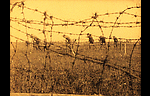
The battle of Zborov: Soldiers overcoming barriers with barbed wires.
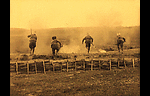
The battle of Zborov: Four soldiers run out a trench.
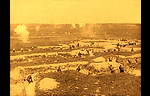
The battle of Zborov: A system of trenches with soldiers.
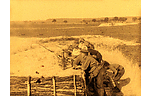
The battle of Zborov: Volunteers in the trench before the assault.
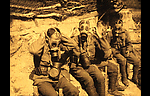
The battle of Zborov: Four Austrian soldiers in gasmasks.
The battle of Zborov: Four Austrian soldiers in the trench with gasmask cases around their necks.
The battle of Zborov: An injured soldier in the barbed wire barrier.
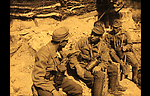
The battle of Zborov: Three soldiers in the trench, Tomeš in the middle.
O. Verf.. „Krieg und Kino.“ Der Kinematograph 397 (1914): 3-4. Bericht, wie bislang der Film in Kriegen eingesetzt worden sei. Ratschläge an Kinobesitzer, wie sie sich zu verhalten hätten. Mutma...
O. Verf.. „Mars regiert die Stunde.“ Der Kinematograph 397 (1914): 5-8. Aufruf an die Kinoindustrie, sich angesichts des Krieges in die Dienste des Vaterlandes zu stellen. Vorschlag, möglichst ak...
Mit der Kamera in der Schlachtfront.“ Der Kinematograph 397 (1914): 7. Werbeanzeige, die die Bedeutung der Filmaufnahmen gerade angesichts des drohenden Krieges hervorhebt.
Aubinger, Josef: „Die Kinematographie in Kriegszeiten.“ Der Kinematograph 398 (1914): 3-5. Artikel, der die mögliche Zukunft des Kinowesens im Krieg beschreibt. Die wirtschaftliche Lage der Kinos...
O. Verf.. „Schliesst die Kinos nicht.“ Der Kinematograph 399 (1914): 3-4. Aufruf an die Kinoindustrie, die Kinos nicht zu schließen, da das Volk in Kriegszeiten Ablenkung brauche. Die Eintrittspr...
Monopolfilm-Vertriebs-GmbH..“Patriotisches Kriegs-Programm.“ Der Kinematograph 399 (1914): 5. Werbung für das aktuelle Filmprogramm der Monopolfilm GmbH.
Asta-Nielsen-Lichtspiele GmbH. „Bismarck. Die neuesten Aufnahmen aus den Kriegstagen.“ Der Kinematograph 400 (1914): 1. Werbung, mit dem Hinweis, dass der Stoff des Filmes den ernsten Kriegstagen ...
O. Verf.. „Der Mangel an Aktualitäten.“ Der Kinematograph 400 (1914): 3-4. Artikel, der den Mangel an aktuellen Aufnahmen aus dem Krieg beklagt. Der Krieg sei die richtige Gelegenheit für die Pr...