The film emphasises the pre-war uniqueness of Britain, rich, insular, with a strong trading position and a free democracy united under the constitutional monarchy. The only pre-war violence comes in t...
(Reel 1) Training the New Army - "cheery non-slackers" undergo PT, drill and bayonet practice, mounting and sabre drill for cavalry. (Reel 2) Manufacture of a 15-inch naval gun and firing trials. (Ree...
Gáthy Lőrinc (a horvát verzióban: Mr. Wickfield) felesége meghal gyermekágyban. Egy nőrokona ajánlkozik, hogy gondját viseli az árván maradt gyermeknek és a háztartásnak, de Gáthy vissz...
I. The build-up to war from the earliest days of film record, showing the various crowned heads of Europe.II. The Balkan wars of 1912, the development of Germany's Navy, and the inauguration of Presid...
(Reel 1) The training of a naval cadet - Pangbourne, HMS Worcester, HMS Medway. (Reel 2) Scenes from the building of a merchant vessel. Shots of a Standard Tanker being launched on the Clyde, female d...
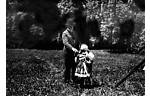
Girl and boy in folk costumes embrace each other on the meadow. Behind them stands the President of the Czechoslovak Republic Tomáš Garrigue Masaryk.
Student Jiří Voldán, after the mobilisation order of 1914, is called up to serve in the Austro-Hungarian army to fight against Russia. With his Czech and Slovak compatriots, he decides to cross to ...
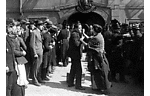
A group of civilians and policemen. In the middle stands infantryman Kubík (actor: Václav Kubásek) on suit. Next to Kubík stands a woman on skirt and shawl.
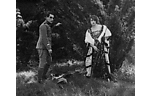
Jiří Voldán (actor: Vladimír Ch. Vladimírov) and his fiancée Maryša (actress: Suzanne Marwille) with the rifle.
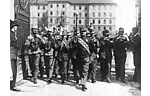
Austrian military band
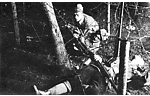
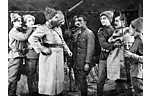
A group of Russian soldiers with fur hats, rifles and bayonets.
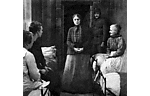
Mother of Jiří Voldán (actress: Marie Ptáková) in the female prison. Another women sit on the bed. At the door stands a soldier.
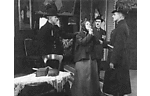
Mother of Jiří Voldán (actress: Marie Ptáková) between two policemen in uniforms. Behind her stands secret policeman.
Rosenthal, Alfred. "Kinoreformatorische Entdeckungsreisen im Regierungsbezirk Minden." Bild & Film. Zeitschrift für Lichtbilderei und Kinematographie III, 1 (1913/1914): 17. A.R. berichtet von seinen...
Sellmann, Adolf. "Neue Lehrhafte Filme (Von Mitte August bis Anfang Oktober)", Bild & Film. Zeitschrift für Lichtbilderei und Kinematographie III, 1 (1913/1914): 20-22. A.S. stellt die neuesten Lehrf...
Dr. Hellwig. "Plakatwesen in Bayern." Bild & Film. Zeitschrift für Lichtbilderei und Kinematographie III, 1 (1913/1914): 23. Das Anbringen von Filmplakaten sei ohne polizeiliche Genehmigung noch imme...
O. Verf.. „Auswüchse in der Reklame der Lichtbildtheater.“ Bild & Film. Zeitschrift für Lichtbilderei und Kinematographie III,1 (1913/1914): 24. Die Stadt Bamberg habe eine Verordnung erlassen, ...
Stein, O. Th.. "Der Kinematograph als moderne Zeitung." Bild & Film. Zeitschrift für Lichtbilderei und Kinematographie III, 2 (1913/1914): 25-28. Stein beschreibt die Wochenschau in den Kinos als sch...
O.Verf.. "Kino und Katholikentag in Metz." Bild & Film. Zeitschrift für Lichtbilderei und Kinematographie III,2 (1913/1914): 40. Auf dem Katholikentag in Metz sei eine Resolution beschlossen worden, ...
Hansen, Fritz. "Photographien als Reklamebilder für Kinotheater" Bild & Film. Zeitschrift für Lichtbilderei und Kinematographie III,2 (1913/1914): 40-42. Hinweise auf das bestehende Urheberrecht in ...
Frankemölle, Wenzel. "In diesem Zeichen wirst du siegen." Bild & Film. Zeitschrift für Lichtbilderei und Kinematographie III,2 (1913/1914): 45-45. Frankemölle lobt den Historienfilm "In hoc signo v...