Images, from 1914, of the production of airplanes: A double-decker is taken outside and the motor is assembled on it. The plane can be transported entirely in parts, as a construction kit.
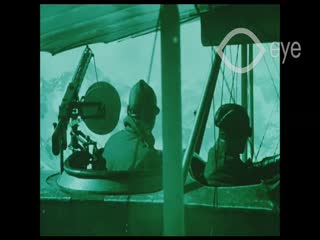
Shots taken from a plane flying above the Alps. Also shots of the plane itself.
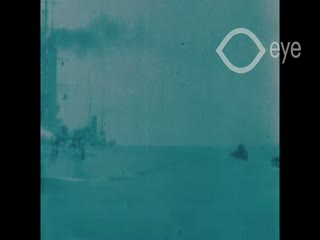
Coloured images of a fleat of several cruisers steaming up.
Melodrama in which the rich and arrogant George promises to give money to the penniless Frank and Jane, on the condition that he could spend the night with Jane. She agrees with this, hoping to save h...
A corporate film by the Maastrichtse Zinkwit Maatschappij (a zinc oxide manufacturer) in Eijsden.
The farmer's daughter and her young man spend idyllic moments in the countryside, riding in a buggy and then rowing on the lake. The girl plucks a daisy: "He loves me, he loves me not..." but of cours...
A melodrama about fratricide and the struggle between two sisters who are each other's opposites. The good sister is declared a madwoman by the bad sister and the child she has of one of the brothers,...
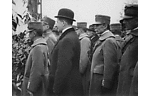
Tomáš Garrigue Masaryk met the king of Italy Vittorio Emanuele III. di Savoia in Batavia.
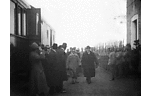
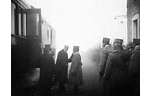
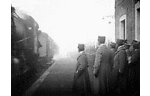
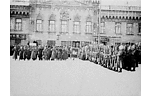
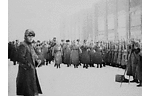
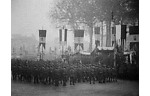
General Štefánik on the visit of the Czechoslovak army in Jekaterinburg. Ceremonial handover of the flag.
General Štefánik on the visit of the Czechoslovak army in Jekaterinburg. On his right side general Jan Syrový.
General Štefánik on the visit of the Czechoslovak army in Jekaterinburg.
Regiments of Czechoslovak volunteers in Padova swear to the flegs with the participation of the Italian king Vittorio Emanuele III. di Savoia and Czech political representation.
Spectator. "Der heutige Stand der Kinoreform." Bild & Film. Zeitschrift für Lichtbilderei und Kinematographie III, 3/4 (1913/ 1914): 49-56. Der Autor warnt vor den Gefahren, die vom Kino ausgingen un...
Häfker, Hermann. "Sind die 'kleinen' Kinotheater der Reform schädlich?" Bild & Film. Zeitschrift für Lichtbilderei und Kinematographie III, 3/4 (1913/1914): 58-60. Häfker geht davon aus, dass die ...
Schumacher, Carl. "Zur 'Kinodramatik'." Bild & Film. Zeitschrift für Lichtbilderei und Kinematographie III, 3/4 (1913/1914): 63-64. Schumacher stellt die Abwesenheit von Dialogen als das Hauptproblem...
O. Verf.. "Kino-Kritik." Bild & Film. Zeitschrift für Lichtbilderei und Kinematographie III, 3/4 (1913/1914): 68-69. Obwohl immer wieder Forderungen nach der Hebung des Niveaus im Kino laut würden, ...
O. Verf.. "Das Kinoplakat." Bild & Film. Zeitschrift für Lichtbilderei und Kinematographie III, 3/4 (1913/1914): 70. Meldung über die zunehmende Hebung des Niveaus von Kinoplakaten. Statt auf grelle...
O. Verf.. "Die Kinematographie auf dem 85. Naturforschertag in Wien." Bild & Film. Zeitschrift für Lichtbilderei und Kinematographie III, 3/4 (1913/1914): 70-71. Meldung über den Einsatz von Filmen ...
O. Verf.. „Polizeiverordnung für das Rheinland.“ Bild & Film. Zeitschrift für Lichtbilderei und Kinematographie III, 3/4 (1913/1914): 72-73. Meldung über den Einsatz von Filmen als illustrieren...
O. Verf.. „Ein Kinematographengesetz in Württemberg.“ Bild & Film. Zeitschrift für Lichtbilderei und Kinematographie, III, 3/4 (1913/1914): 73. Jeder Film, der öffentlich vorgeführt werde, mü...