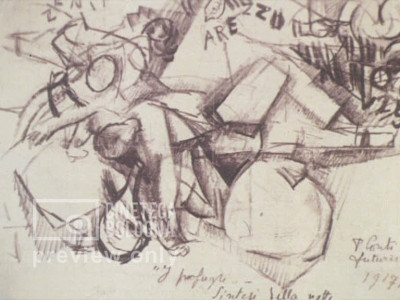
Il pittore Primo Conti (1900 - 1988) legge un libro nella sua casa di Fiesole, vengono poi ricordati i suoi esordi negli anni Dieci quando, giovanissimo, inizia a dipingere influenzato dai fauve...
Film restored in collaboration with Cinémathèque Française.
Il film, alternando alle riprese molte fotografie e filmati di repertorio, ripercorre la vita e la carriera del compositore ungherese Béla Bartók (1881-1945). Nato a Nagyszentmiklós (San Nicc...
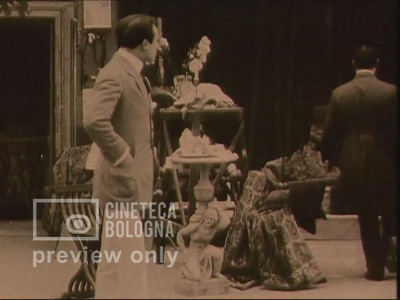
In un piccolo paese dell'Umbria vive il conte di San Secondo con sua figlia Elena, la quale ama in segreto il pittore Paolo Ardenti, un giovane di modeste origini. Rovinato da un'errata speculaz...
Si ripercorrono gli anni che crearono i presupposti per l'unità d'Italia, servendosi prevalentemente di materiale iconografico d’epoca. La battaglia di Novara e la fine della prima guerra d...
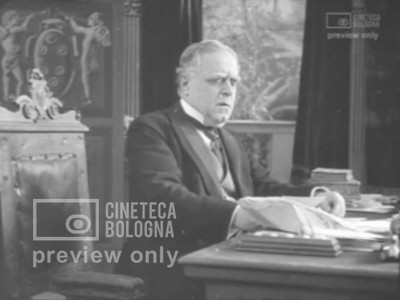
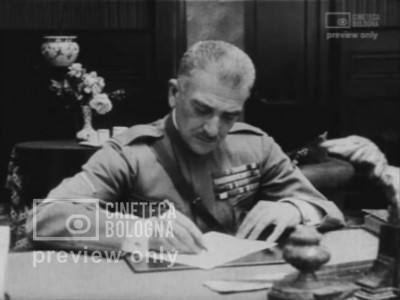
Il Generale Armando Diaz scrive un documento alla scrivania. Restaurato a partire da un frammento negativo d’epoca appartenente al fondo Fausto Correra.
Film restored in collaboration with Cinémathèque Suisse.
Spari di artiglieria di navi da guerra battenti bandiera italiana. Restaurato a partire da un frammento positivo d’epoca appartenente al fondo Fausto Correra.
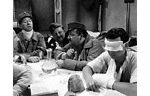
Medium shot of several men sitting around a table with a half loaf of bread and a carafe of water. On the left sits Sakař (actor: Jindřich Plachta) with a bandaged neck. To the right sit Vyskočil (...
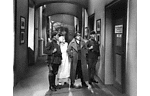
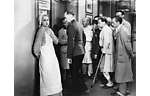
Wide shot of a corridor. Standing in front of the door to Dr. Šrámek's office are Nurse Mathilde (actress: Adina Mandlová) and Rjepkin (actor: Vladimír Borský) flanked by Austrian military guards...
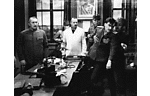
View of an office. A colonel of the Austrian army (actor: Jaroslav Marvan) and Dr. Šrámek (actor: František Smolík) are standing at a desk. Behind Šrámek are two military guards (on the right, a...
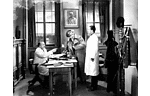
Wide shot of an office. Dr. Šrámek (actor: František Smolík) is sitting at a desk and pointing at another doctor standing on the opposite side of the desk. Rjepkin (actor: Vladimír Borský) is st...
Wide shot of a corridor and a door with a sign indicating "MUDr. Fr. Šrámek." Standing in front of the door are nurse Mathilde (actress: Adina Mandlová), First Lieutenant Liška (actor: František ...
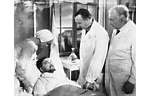
Lieutenant Rjepkin (actor: Vladimír Borský) is lying on a hospital bed in the foreground. Three figures are standing over him: Nurse Mathilde (actor: Adina Mandlová) on the left, and doctors Šrám...
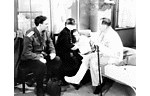
View of a hospital room. In the centre of the image, cadet Severa (actor: Stanislav Strnad) is lying on a bed and hugging his mother (actress: Marie Ptáková), who is sitting next to him. Rjepkin is ...
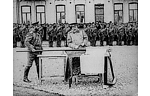
Hammering nails into flagpole of Czech legion and ceremonial blessing of the flag (28th September 1914) in Kiev.
Robert Neulaender, Kino und Krieg, Bild & Film. Zeitschrift für Lichtbilderei und Kinematographie, IV, 12, (1914/1915), S. 256-257. Die Filmberichte über das "Neueste vom Kriegsschauplatz" seien eig...
E. Osten, Kinematographie des Krieges, Erste Internationale Filmzeitung, 9.Jg., Nr.21, (1915), S. 16-18. Bericht über den Einsatz aus dem Flugzeug aufgenommener Filme zur Aufklärung feindlicher Stel...
P.l., Kinematographische Kriegsberichterstattung, Erste Internationale Filmzeitung, 9.Jg.,Nr.22, (1915), S. 27. Die filmischen Kriegsneuheiten seien anfangs sehr begeistert aufgenommen worden, würden...
Kurbelmann im Kriegsdienst, Der Kinematograph, 436, (1915), S. 21-24. Aus der Wiener Arbeiter-Zeitung zitierter Bericht über die Erlebnisse eines Kriegsfilmers.
Kriegsabenteuer eines Kino-Operateurs, Der Kinematograph, 437, (1915), S. 14-15. Erlebnisbericht des Müncher Kameramanns Martin Kopp von seinen Erlebnissen als Kriegsberichterstatter.
B.T., Messters Kriegskinos, Der Kinematograph, 437, (1915), S. 19. Meldung, dass die Firma Messter die Erlaubnis bekommen habe, regelmäßig an der Westfront Filmaufnahmen zu machen.
Dr. Weiser, Der Ernemann-Kinox im Felde, Der Kinematograph, 438, (1915), S. 21. Bericht über die Eröffnung eines Feldkinos. Beigefügt ist ein Bild des Kinos mit seinen Besuchern. Der Verfasser kün...
National Film G.m.b.H. "Wir Barbaren", Der Kinematograph, 439, (1915), S. 20-22. Rezension einer Komödie, die die französische Propaganda gegen Deutschland aufgreift.