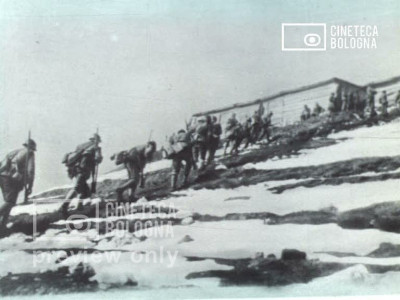
Ricostruzione degli eventi principali della prima guerra mondiale, con particolare attenzione alle vicende italiane, un largo utilizzo di grafici, cartine, illustrazioni, fotografie, e il freque...
Livorno was just a lively center of Macchiaioli art as Florence. Many artists painted in Livorno including Cristiano Banti, Giovanni Boldini and, on the most painted waterfront in Italy, Vincenz...
Il film, utilizzando materiali iconografici di repertorio, riprese sui luoghi reali e ricostruzioni narrative in assenza di personaggi, rievoca gli episodi più significativi della seconda guerr...
The work and the life of the writer Giovanni Boine.
Some moments of Umberto Saba’s poetry.
Si ricostruisce la vita di Giuseppe Melchiorre Sarto (1835-1914), nominato papa nel 1903, attraverso fotografie e immagini dei luoghi in cui visse. La prima parte è dedicata a Riese, in provinc...
The documentary reconstructs World War I through the letters of fighting soldiers. Both the situations in Italy and in other warring nations are taken into consideration.
Until today one of the most mysterious figures in Italian cinema has been, without a doubt, Lucio D’Ambra. Recent finds of his works permit a more accurate outline of a personality capable of ...
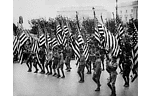
American soldiers sent to France march with the American flags in the streets of Paris.
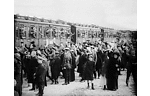
Mobilization in Germany. German soldiers wave from the windows of the train before leaving for the front.
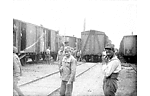
Czechoslovak volunteers on a small station in Siberia.
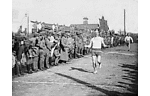
Czechoslovak volunteers relax - a run competition.
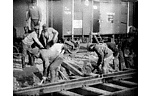
Technical troops maintained in good repair railway tracks - covering the underside of rails.
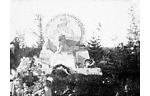
A monument with a stone lion - a symbol of Czech statehood- on the grave of fallen volunteers.
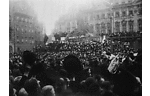
Welcome of the President T.G. Masaryk after his arrival in the country. On the monument of Jan Hus is a banner with the slogan "People of Jan Hus".
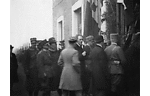
Tomáš Garrigue Masaryk met the king of Italy Vittorio Emanuele III. di Savoia in Batavia.
Spectator. "Der heutige Stand der Kinoreform." Bild & Film. Zeitschrift für Lichtbilderei und Kinematographie III, 3/4 (1913/ 1914): 49-56. Der Autor warnt vor den Gefahren, die vom Kino ausgingen un...
Häfker, Hermann. "Sind die 'kleinen' Kinotheater der Reform schädlich?" Bild & Film. Zeitschrift für Lichtbilderei und Kinematographie III, 3/4 (1913/1914): 58-60. Häfker geht davon aus, dass die ...
Schumacher, Carl. "Zur 'Kinodramatik'." Bild & Film. Zeitschrift für Lichtbilderei und Kinematographie III, 3/4 (1913/1914): 63-64. Schumacher stellt die Abwesenheit von Dialogen als das Hauptproblem...
O. Verf.. "Kino-Kritik." Bild & Film. Zeitschrift für Lichtbilderei und Kinematographie III, 3/4 (1913/1914): 68-69. Obwohl immer wieder Forderungen nach der Hebung des Niveaus im Kino laut würden, ...
O. Verf.. "Das Kinoplakat." Bild & Film. Zeitschrift für Lichtbilderei und Kinematographie III, 3/4 (1913/1914): 70. Meldung über die zunehmende Hebung des Niveaus von Kinoplakaten. Statt auf grelle...
O. Verf.. "Die Kinematographie auf dem 85. Naturforschertag in Wien." Bild & Film. Zeitschrift für Lichtbilderei und Kinematographie III, 3/4 (1913/1914): 70-71. Meldung über den Einsatz von Filmen ...
O. Verf.. „Polizeiverordnung für das Rheinland.“ Bild & Film. Zeitschrift für Lichtbilderei und Kinematographie III, 3/4 (1913/1914): 72-73. Meldung über den Einsatz von Filmen als illustrieren...
O. Verf.. „Ein Kinematographengesetz in Württemberg.“ Bild & Film. Zeitschrift für Lichtbilderei und Kinematographie, III, 3/4 (1913/1914): 73. Jeder Film, der öffentlich vorgeführt werde, mü...