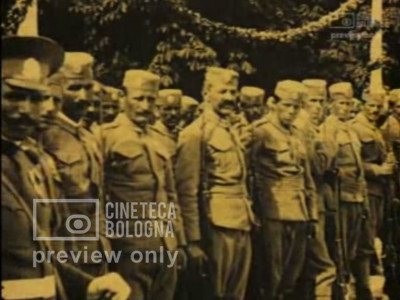
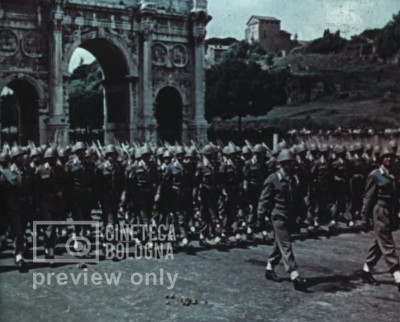
Vittorio Emanuele III di Savoia e la reale consorte Elena del Montenegro in visita ufficiale al re del Montenegro Nicola I, presso la villa reale di Rijeka Crnojevića. Il principe Ereditario Da...
The history and life of the military corps the Grenadiers of Sardinia.
Strade di Cettigne, capitale del Regno del Montenegro. Il Palazzo dei Ministri e delle Regie Poste. Il nuovo palazzo della Legazione Italiana. Il Teatro Reale. Il Palazzo Reale. Nicola I, Re del...
The film reviews the history and art of Vienna and the empire of which it was the capital for centuries, ending with a vision of the contemporary city.
Marinetti, definito da Boccioni “poeta e impresario”, dopo la pubblicazione del primo manifesto futurista su “Le Figaro” (1909) diffonde il Manifesto tecnico della letteratura futurista,...
Špilberk is a picturesque castle dominating the modern city of Brno (Czech Republic). Over the course of time it has been a fortress, prison, museum and a place for torture. During the Inquisit...
La voce fuori campo, con accento dialettale, è quella di un emigrato del sud Italia in America, che racconta come la prima cosa che all'estero si rimpiange della madrepatria sia l'olio. Si vede...
01 – Cinema (Roma, 16/11/1976) Sulle pagine di alcuni quotidiani, articoli che parlano della crisi che sta attraversando il cinema italiano. L'attrice Agostina Belli, sul set cinematografico, ...
Medium shot of an Austrian soldier, Dr. Šrámek (actor: František Smolík), Nurse Mathilde (actress: Adina Mandlová), and other doctors standing by a desk in an office.
Wide shot of an Austrian soldier, Dr. Šrámek (actor: František Smolík), Nurse Mathilde (actress: Adina Mandlová), and other doctors standing by a desk in an office.
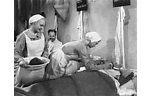
Medium shot of two nurses. Tonička (actress: Truda Grosslichtová) is holding a wash basin with a sponge and Mathilde (actress: Adina Mandlová) is washing the face of a lying patient. In the backgro...
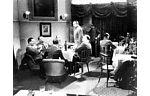
Wide shot of a café. Austrian officers sit around tables on the right and left (second from left is actor Jaroslav Marvan). Dr. Šrámek (actor: František Smolík) is standing next to the table on t...
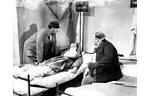
View of a hospital room. Infantryman Sakař (actor: Jindřich Plachta) is lying on a bed with a bandaged neck and closed eyes. Leaning over him to the left is infantryman Tlamicha (actor: Theodor Piš...
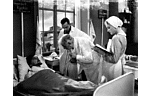
In the foreground, Lieutenant Rjepkin is lying on a hospital bed. Two doctors and Nurse Mathilde (actress: Adina Mandlová) are standing over him. Dr. Klíma (actor: Karel Veverka) has a stethoscope i...
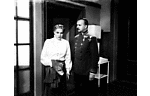
Medium shot of Nurse Mathilde (actress: Adina Mandlová) in civilian clothing and Dr. Šrámek (actor: František Smolík) in an officer's uniform. They are standing in a corridor.
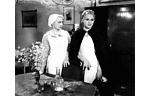
Medium shot of nurses Tonička (actress: Truda Grosslichtová) and Mathilde (actress: Adina Mandlová) standing by a table in a room. Mathilde has a paletot over her shoulders and is staring fixedly s...
Die Verfilmung von Königlichen Lazarettbesuchen in der "Eiko-Woche", Der Kinematograph, 441, (1915), S. 10. Bericht über die Absicht de Eiko-Woche, nicht nur Kämpfe zu filmen, sondern auch das mili...
Gefahren bei der Aufnahme von Schlachtenfilms, Der Kinematograph, 443, (1915), S. 19. Die Annahme, dass viele Kriegsaufnahmen gestellt seien, sei unzutreffend. So sei einem Kameramann der Firma Messte...
Kriegsbilder-Revuen, Der Kinematograph, 419, (1915), S. 13. Die Aufnahmen, die das Volk vom Krieg zu sehen bekomme, seien oft nicht informativ genug, weil sie aus Zensurgründen gekürzt seien. Es sei...
Der Soldat und das Kino, Der Kinematograph, 420, (1915), S. 11-12. In vielen Kinos würden Soldaten auf Heimaturlaub einen Großteil des Publikums bilden. Viele Kinobesitzer würden glauben, dass dies...
Das erste Feldkino, Der Kinematograph, 421, (1915), S. 24. Bericht über die Eröffnung eines Feldkinos, der aus der Zeitung des 15. Armeekorps zitiert wird.
Englische Beobachtungen im Berliner Kino, Der Kinematograph, 421, (1915), S. 27. Bericht, der aus der Londoner "Daily Mail" zitiert wird und die Eindrücke eines englischen Reporters von einer Wochens...
Berthold Baer, Amerikana, Der Kinematograph, 422, (1915), S. 21-22. Die Stimmung in den USA sei durch Filme der Ententemächte sehr gegen Deutschland gestimmt. Die Deutschen seien sich nicht darüber ...
[Lustbarkeitssteuer für Kinos], Der Kinematograph, 424, (1915), S. 35. Bericht über Beratungen zur Lustbarkeitssteuerverordnung der Stadt Essen. Grund sei die hohe Zunahme der Zahl der Kinobesitzer ...