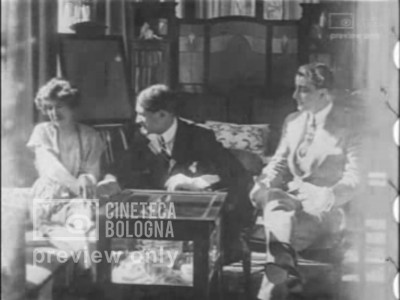
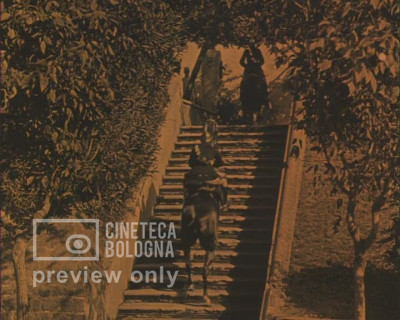
Frammenti della versione cinematografica del celebre feuilleton di Carolina Invernizio.
A short film about the painter Gino Rossi: his life, art, struggle against the academies, conformity and middle class duplicity. His dissent is unyielding, his life complete freedom, but he ends...
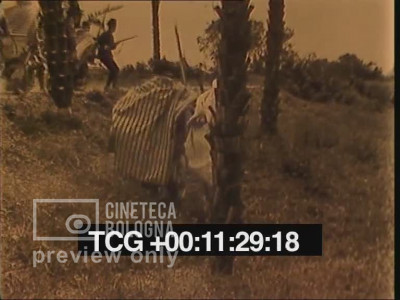
A patriotic film tinged with humor and sentimentalism. Stock footage (the crowded town, the departure of warships) and reconstructed war scenes in the desert are part of the second half about th...
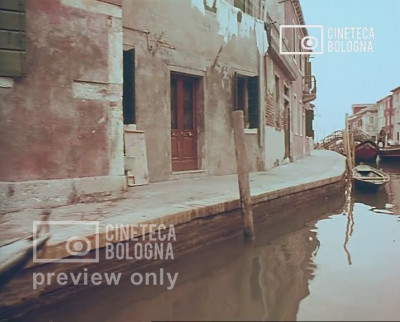
The life of the parish priest don Giovanni Minzoni is reconstructed from adolescence to adulthood, from pastoral mission to extreme sacrifice. The film visits the places of his youth in his home...
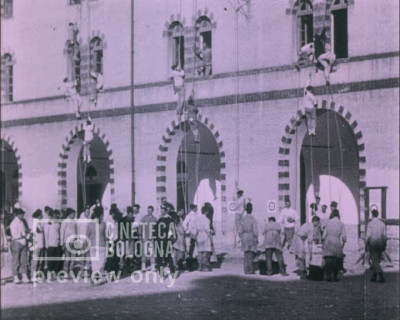
Documentary footage of the exercises of the bersaglieri corps.
01 – Visita (Roma, 26/10/1967) Nella basilica di San Pietro, in Vaticano, Papa Paolo VI ed il Patriarca di Costantinopoli Atenagora partecipano a una cerimonia religiosa per avvicinare la chie...
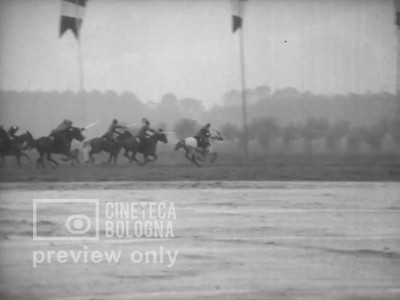
An exciting series of pictures of daring horsemanship. The film is full of thrilling episodes, and is asubject that should prove highly popular. "The Bioscope", 8th September 2010.
01 – Nel mondo (Praga - Karlovy Vary - Bucarest - Parigi - Bonn, 8-18/05/1968) Su una cartina geografica dell'Europa viene mostrata in dettaglio la Cecoslovacchia e la sua capitale, Praga. Imm...
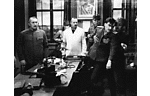
Medium shot of several men sitting around a table with a half loaf of bread and a carafe of water. On the left sits Sakař (actor: Jindřich Plachta) with a bandaged neck. To the right sit Vyskočil (...
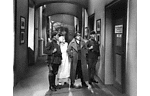
Wide shot of a corridor. Standing in front of the door to Dr. Šrámek's office are Nurse Mathilde (actress: Adina Mandlová) and Rjepkin (actor: Vladimír Borský) flanked by Austrian military guards...
View of an office. A colonel of the Austrian army (actor: Jaroslav Marvan) and Dr. Šrámek (actor: František Smolík) are standing at a desk. Behind Šrámek are two military guards (on the right, a...
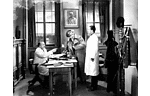
Wide shot of an office. Dr. Šrámek (actor: František Smolík) is sitting at a desk and pointing at another doctor standing on the opposite side of the desk. Rjepkin (actor: Vladimír Borský) is st...
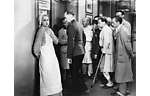
Wide shot of a corridor and a door with a sign indicating "MUDr. Fr. Šrámek." Standing in front of the door are nurse Mathilde (actress: Adina Mandlová), First Lieutenant Liška (actor: František ...
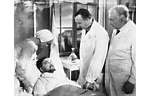
Lieutenant Rjepkin (actor: Vladimír Borský) is lying on a hospital bed in the foreground. Three figures are standing over him: Nurse Mathilde (actor: Adina Mandlová) on the left, and doctors Šrám...
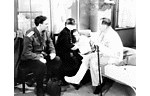
View of a hospital room. In the centre of the image, cadet Severa (actor: Stanislav Strnad) is lying on a bed and hugging his mother (actress: Marie Ptáková), who is sitting next to him. Rjepkin is ...
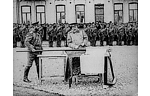
Hammering nails into flagpole of Czech legion and ceremonial blessing of the flag (28th September 1914) in Kiev.
O. Verf.. „Krieg und Kino.“ Der Kinematograph 397 (1914): 3-4. Bericht, wie bislang der Film in Kriegen eingesetzt worden sei. Ratschläge an Kinobesitzer, wie sie sich zu verhalten hätten. Mutma...
O. Verf.. „Mars regiert die Stunde.“ Der Kinematograph 397 (1914): 5-8. Aufruf an die Kinoindustrie, sich angesichts des Krieges in die Dienste des Vaterlandes zu stellen. Vorschlag, möglichst ak...
Mit der Kamera in der Schlachtfront.“ Der Kinematograph 397 (1914): 7. Werbeanzeige, die die Bedeutung der Filmaufnahmen gerade angesichts des drohenden Krieges hervorhebt.
Aubinger, Josef: „Die Kinematographie in Kriegszeiten.“ Der Kinematograph 398 (1914): 3-5. Artikel, der die mögliche Zukunft des Kinowesens im Krieg beschreibt. Die wirtschaftliche Lage der Kinos...
O. Verf.. „Schliesst die Kinos nicht.“ Der Kinematograph 399 (1914): 3-4. Aufruf an die Kinoindustrie, die Kinos nicht zu schließen, da das Volk in Kriegszeiten Ablenkung brauche. Die Eintrittspr...
Monopolfilm-Vertriebs-GmbH..“Patriotisches Kriegs-Programm.“ Der Kinematograph 399 (1914): 5. Werbung für das aktuelle Filmprogramm der Monopolfilm GmbH.
Asta-Nielsen-Lichtspiele GmbH. „Bismarck. Die neuesten Aufnahmen aus den Kriegstagen.“ Der Kinematograph 400 (1914): 1. Werbung, mit dem Hinweis, dass der Stoff des Filmes den ernsten Kriegstagen ...
O. Verf.. „Der Mangel an Aktualitäten.“ Der Kinematograph 400 (1914): 3-4. Artikel, der den Mangel an aktuellen Aufnahmen aus dem Krieg beklagt. Der Krieg sei die richtige Gelegenheit für die Pr...