The film emphasises the pre-war uniqueness of Britain, rich, insular, with a strong trading position and a free democracy united under the constitutional monarchy. The only pre-war violence comes in t...
(Reel 1) Training the New Army - "cheery non-slackers" undergo PT, drill and bayonet practice, mounting and sabre drill for cavalry. (Reel 2) Manufacture of a 15-inch naval gun and firing trials. (Ree...
The wife of Lőrinc Gáthy (Mr. Wickfield in the Croatian version) dies in childbirth. A female relative offers to take care of the motherless child and the household, but Gáthy declines the offer be...
I. The build-up to war from the earliest days of film record, showing the various crowned heads of Europe.II. The Balkan wars of 1912, the development of Germany's Navy, and the inauguration of Presid...
(Reel 1) The training of a naval cadet - Pangbourne, HMS Worcester, HMS Medway. (Reel 2) Scenes from the building of a merchant vessel. Shots of a Standard Tanker being launched on the Clyde, female d...
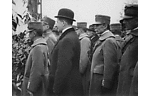
Tomáš Garrigue Masaryk met the king of Italy Vittorio Emanuele III. di Savoia in Batavia.
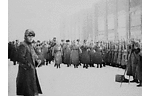
General Štefánik on the visit of the Czechoslovak army in Jekaterinburg. Ceremonial handover of the flag.
General Štefánik on the visit of the Czechoslovak army in Jekaterinburg. On his right side general Jan Syrový.
General Štefánik on the visit of the Czechoslovak army in Jekaterinburg.
Regiments of Czechoslovak volunteers in Padova swear to the flegs with the participation of the Italian king Vittorio Emanuele III. di Savoia and Czech political representation.
St., O.Th.. "Lichtbildliches aus Sachsens Residenz." Bild & Film. Zeitschrift für Lichtbilderei und Kinematographie III,7 (1913/1914): 174. Bericht über das Dresdner Kinowesen. U.a wird auch das Jug...
Bergmann. "Die Frage eines Kinematographengesetzes für Preußen." Bild & Film. Zeitschrift für Lichtbilderei und Kinematographie III, 7 (1913/1914): 175-177. Erörterung des geplanten Kinogesetzes f...
O. Verf.. "Filmempfehlungen der Lichtbilderei GmbH M.Gladbach." Bild & Film. Zeitschrift für Lichtbilderei und Kinematographie III,7 (1913/1917). Die genannten Filme (Quo Vadis, Die Jungfrau von Orle...
Rennert, Malwine. „"Schatten im Licht“, eine Schmähschrift gegen die Lichtbilderei M.Gladbach." Bild & Film. Zeitschrift für Lichtbilderei und Kinematographie III,8 (1913/1914): 195-196. Rennert...
Rosenthal, Alfred. „Kinovorstellungen in Vereinen.“ Bild & Film. Zeitschrift für Lichtbilderei und Kinematographie III,8 (1913/1914): 198-200. Ratgeber mit Vorschlägen, wie Filmvorführungen in ...
Hilda Blaschitz. „Tirol in Waffen (Andreas Hofer).“ Bild & Film. Zeitschrift für Lichtbilderei und Kinematographie III,8 (1913/1914): 207-208. Blaschitz lobt den Film und hebt insbesondere hervor...
Rennert, Malwine. „Gabriele d'Annunzio als Filmdichter.“ Bild & Film. Zeitschrift für Lichtbilderei und Kinematographie, III, 9/10 (1913/1914): 210-213. Rennert lobt den Film über alle Maßen, w...
O. Verf.. „Deutschlands Ein- und Ausfuhr von Kinofilmen im Jahre 1912.“ Bild & Film. Zeitschrift für Lichtbilderei und Kinematographie, III, 9/10 (1913/1914): 236. Wirtschaftsstatistiken aus dem ...