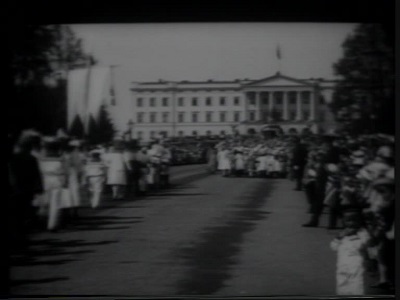
The film shows the visit of King Haakon 7th to the city of Sandefjord in 1916.
The film gives a vivid and lively picture of landscape, buildings, industry and everyday life in the small city of Sandefjord in the southern parts of Norway.
Norwegian soldiers at military exercise in Northern Norway.
Newsreel with international and Norwegian content, among others shipbuilding, sailing, Pickford and Fairbanks' wedding, and winter sport activities.
Report from the ski jumping competition at the Holmenkollen ski jump in Oslo in 1917.
From the celebration of the Norwegian national day, the 17th of May, in the capital Kristiania, later named Oslo. The day is celebrated traditionally with choral singing, brass bands and children's ...
The film shows May Day parades and other arrangments under the auspices of the labour movement in Norway.
Two events in the city of Kristiansand around 1918: A rich Norwegian emigrant returns from America, and a memorial for sailors killed in World War I is unveiled.
Wounded soldiers eat in a hospital room.
A military doctor shows a wounded soldier to a Red Cross delegation.
Requisition of horses.
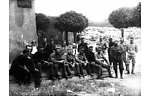
Conscripts in the assembly camp.
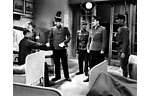
Wide shot of a hospital room. A standing First Lieutenant Schranel (actor: Vladimír Pospíšil-Born) shakes hands with First Lieutenant Liška (actor: František Kreuzmann), who is sitting on a bed w...
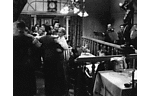
View of a dance café. Several couples are dancing on the left, including First Lieutenant Schranel (actor: Vladimír Pospíšil-Born) and Nurse Mathilde (actress: Adina Mandlová). To the right of th...
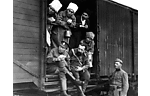
Exterior view of a train. Six Russian soldiers (prisoners of war) with Asian features are sitting or standing in the train's open door. Some of the soldiers are holding bread in their hands and all ar...
O. Verf.. „Krieg und Kino.“ Der Kinematograph 397 (1914): 3-4. Bericht, wie bislang der Film in Kriegen eingesetzt worden sei. Ratschläge an Kinobesitzer, wie sie sich zu verhalten hätten. Mutma...
O. Verf.. „Mars regiert die Stunde.“ Der Kinematograph 397 (1914): 5-8. Aufruf an die Kinoindustrie, sich angesichts des Krieges in die Dienste des Vaterlandes zu stellen. Vorschlag, möglichst ak...
Mit der Kamera in der Schlachtfront.“ Der Kinematograph 397 (1914): 7. Werbeanzeige, die die Bedeutung der Filmaufnahmen gerade angesichts des drohenden Krieges hervorhebt.
Aubinger, Josef: „Die Kinematographie in Kriegszeiten.“ Der Kinematograph 398 (1914): 3-5. Artikel, der die mögliche Zukunft des Kinowesens im Krieg beschreibt. Die wirtschaftliche Lage der Kinos...
O. Verf.. „Schliesst die Kinos nicht.“ Der Kinematograph 399 (1914): 3-4. Aufruf an die Kinoindustrie, die Kinos nicht zu schließen, da das Volk in Kriegszeiten Ablenkung brauche. Die Eintrittspr...
Monopolfilm-Vertriebs-GmbH..“Patriotisches Kriegs-Programm.“ Der Kinematograph 399 (1914): 5. Werbung für das aktuelle Filmprogramm der Monopolfilm GmbH.
Asta-Nielsen-Lichtspiele GmbH. „Bismarck. Die neuesten Aufnahmen aus den Kriegstagen.“ Der Kinematograph 400 (1914): 1. Werbung, mit dem Hinweis, dass der Stoff des Filmes den ernsten Kriegstagen ...
O. Verf.. „Der Mangel an Aktualitäten.“ Der Kinematograph 400 (1914): 3-4. Artikel, der den Mangel an aktuellen Aufnahmen aus dem Krieg beklagt. Der Krieg sei die richtige Gelegenheit für die Pr...