Propaganda film from Oslo Labour Party, with focus on housing policy, in connection with the local election in 1928.
The film is part of the election campaign for The Norwegian Labour Party in 1930 and argues against the militarism of the Conservative Party. Scenes from World War I illustrates the horrors of the war...
In January 1916 there was a great fire in Bergen, where almost 400 buildings burned down and 2700 people lost their homes. The film shows the clean-up of the ruins.
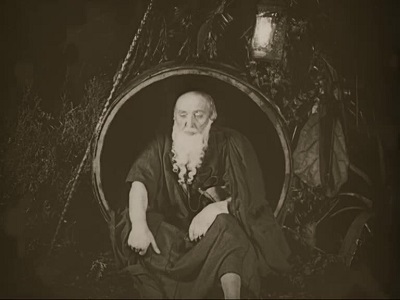
A commercial for Rex Margarine with the Greek philosopher Diogenes as the main character.
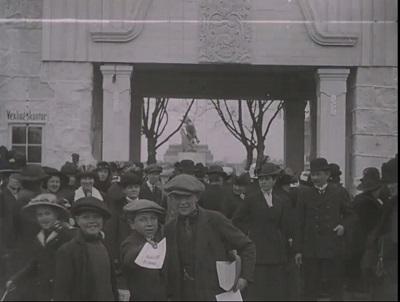
Various clips from Oslo 1912-14. The opening of the 100th Anniversary Exhibition, May 15, 1914, with people waiting to get in. Market stalls and trade in Oslo city centre. The departure of one of The ...
Newsreel showing the breakdown of the relation between USA and Germany in 1917, in addition to pictures from the American Navy, female train conductors and polar bears in a Paris zoo.
Newsreel in three parts: a football match with female players, the autumn fashion from Paris, and the favourite sport of cowboys, which seems to be gymnastics.
Commercial for Freia chocolates.
American soldiers sent to France march with the American flags in the streets of Paris.
Mobilization in Germany. German soldiers wave from the windows of the train before leaving for the front.
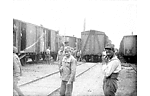
Czechoslovak volunteers on a small station in Siberia.
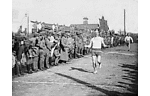
Czechoslovak volunteers relax - a run competition.
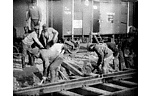
Technical troops maintained in good repair railway tracks - covering the underside of rails.
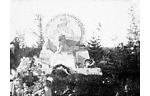
A monument with a stone lion - a symbol of Czech statehood- on the grave of fallen volunteers.
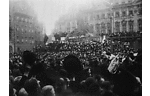
Welcome of the President T.G. Masaryk after his arrival in the country. On the monument of Jan Hus is a banner with the slogan "People of Jan Hus".
Tomáš Garrigue Masaryk met the king of Italy Vittorio Emanuele III. di Savoia in Batavia.
P., E.. „Französische und englische Films!.“ Der Kinematograph 400 (1914): 7-8. Der Verfasser behauptet, das Filmwesen sei von französischen Agenten beeinflusst. Jahrzehntelang hätten französi...
O. Verf.. „Der Kinematograph im Dienste des Heeres.“ Der Kinematograph 401 (1914): 3-4. Artikel über die Möglichkeiten, Filmtechnik militärisch nutzbar zu machen. Der Film sei nicht nur zu Zwec...
Martin Dentler GmbH. „Die richtigen Films zur richtigen Zeit.“ Der Kinematograph, 401 (1914): 11. Werbeanzeige, die mit der Bedeutung der beworbenen Filme angesichts des Krieges wirbt.
Eiko Film. „"Eiko-Woche“ ist die beste Kriegsberichterstattung" Der Kinematograph 404 (1914): 1.
Emscher, Horst: „Der Krieg und die deutsche Filmindustrie.“ Der Kinematograph 404 (1914): 5-6. Erörterung der wirtschaftlichen Lage der deutschen Filmindustrie. Entgegnet dem Vorwurf, dass die Be...
O. Verf.. „Das Programm in Kriegszeiten.“ Der Kinematograph 405 (1914): 8. Obwohl viele Kinos geschlossen hätten, würden die Besucherzahlen in den Kinos immer weiter zunehmen. Dies sei insbesond...
Eiko Film, Ich kenne keine Parteien mehr, Der Kinematograph, 406, (1914), S. 1. Werbeanzeige mit Hinweis auf "Beseitigung der Zensurschwierigkeiten".
Nordisk Films GmbH, Jede Woche neue Kriegs-Aufnahmen, Der Kinematograph 406, (1914), S. 3. "Jede Woche abwechselnd neue Kriegsaufnahmen vom Westen und Osten (eigene Expeditionen)".